
Smart Home for Night Feeds: Lights, White Noise, and Quiet Handoffs
At 3 AM, the hardest part of a night feed often isn't the feeding — it's everything around it. Finding a switch in the dark, deciding whether to keep your phone face-down so the screen doesn't wake the baby, working out which side you used last, judging whether to wake your partner. Each of those small decisions feels heavier than it should at that hour.
A few quiet pieces of home automation can lift several of those decisions out of the moment. Lights dim themselves when you start a feed. Do Not Disturb engages. A soft white-noise loop begins. When you stop the timer, everything reverses. None of it is loud or futuristic — and once it's set up, it does not ask anything of you again.
Try Amme for free — the nursing timer that triggers your night routine.
Why Lighting Matters Most
Of all the night-feed levers, lighting is the one with the clearest evidence behind it. Cool, bright light at night suppresses melatonin in both parents and infants and pushes the body's circadian rhythm toward "morning". Warm, dim light has the opposite effect — it preserves the hormonal cues that say it is still sleep time.
Practically, this means three things:
- Avoid bright overhead lights during night feeds. Even a few seconds of full kitchen-style lighting can reset the room's sleep cue.
- Choose warm tones — 2200 K or lower is gentler than the standard 2700 K of most bedroom bulbs. Many smart bulbs can shift down into amber or candle ranges.
- Keep brightness low — around 5–10% of full output is usually plenty to see a latch, a nappy, and the way back to bed.
Most parents find that one small lamp at low brightness on the side they nurse from is the entire lighting story. The rest of the room can stay dark.
HomeKit, Matter, and What Actually Talks to Amme
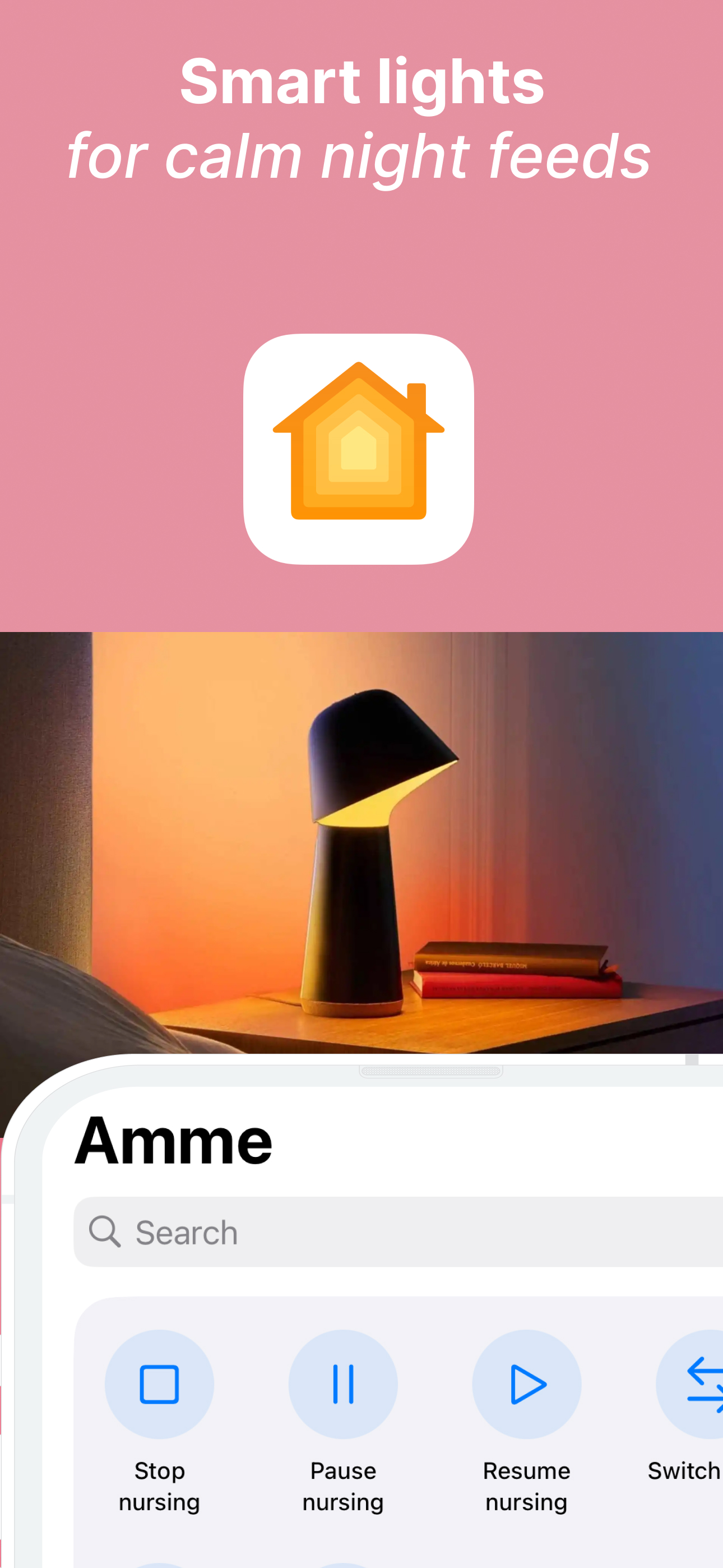
You do not need a specific ecosystem to make this work. Amme runs on iOS Shortcuts, which can drive any smart device that appears in Apple's Home app or has a Shortcuts action of its own.
- HomeKit is Apple's home-automation framework. Devices that support it appear in the Home app and can be controlled by Shortcuts directly.
- Matter is a newer cross-ecosystem standard. Matter-compatible devices show up in HomeKit, Google Home, and Amazon Alexa at the same time, which means you are not locked in if you later switch.
- Philips Hue, LIFX, Nanoleaf, Lutron, IKEA Trådfri, Aqara and most other major brands work either through HomeKit or Matter, and all of them are controllable from a Shortcut that Amme triggers.
For most night-feed setups, a single HomePod mini or an always-on Apple TV acts as the hub that keeps automations running reliably when your iPhone is asleep on the bedside table. You do not need anything more elaborate to begin.
Triggering Your Routine From the Amme Timer
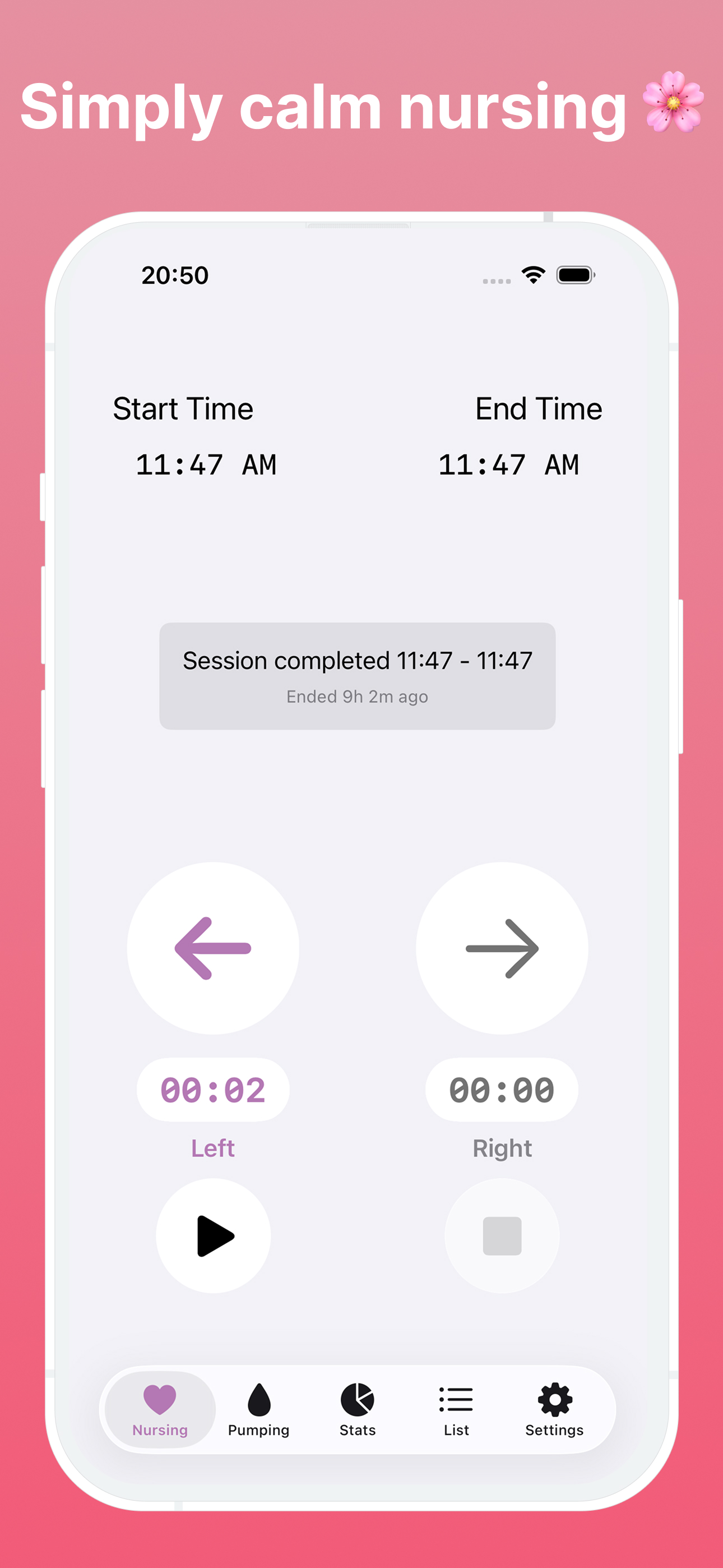
The piece that connects your nursing routine to the rest of your home is the iOS Shortcuts integration in Amme. When you tap to start a session, Amme can run a shortcut. When you tap to stop, it can run a second shortcut that reverses everything.
A first shortcut might do:
- Dim the bedroom lamp to 5% in a warm tone
- Enable Sleep Focus or Do Not Disturb until the session ends
- Start a low-volume white-noise loop on the bedroom HomePod
- Lower the thermostat by one degree
- Send a silent message to your partner — "feed started"
A second shortcut, run when the session ends:
- Restore the previous lighting scene
- End the white-noise loop
- Disable Do Not Disturb (or leave it on until morning)
- Send a quiet ping to the partner if it is their turn
You build both shortcuts once in Apple's Shortcuts app — drag-and-drop, no code — and from then on every session triggers them. There is nothing to remember mid-feed.
A Few Setup Recipes
These are the ones most night-nursing parents land on after a couple of weeks. Each takes a few minutes to build.
The Quiet Night Feed
Trigger: nursing session starts in Amme.
- Set bedroom lamp to 5% warm-amber
- Enable Sleep Focus
- Start "Brown Noise" playlist on bedroom HomePod at 20% volume
Reverse trigger: session stops.
- Restore previous scene
- Pause HomePod audio
- Leave Sleep Focus on until 7 AM
Side-Lying Wake-Up Helper
Trigger: nursing session lasts longer than 25 minutes between midnight and 5 AM (a sign you may have drifted off mid-feed).
- Slowly raise lamp brightness to 15% over 60 seconds
- Send a gentle haptic to your Apple Watch
This is one a few parents add after a couple of weeks of side-lying nursing. It is not for everyone, and it is not a safety system — see Night Nursing for what actually matters around safe sleep — but some parents find it a quiet way to keep themselves from sleeping on a feed.
Partner Handoff
Trigger: smart button on the bedside table.
- Send "It's your turn" message to partner
- Slowly raise their bedside lamp to 10%
- Pause your own white-noise loop
Some parents prefer this to a verbal handoff. The partner's lamp comes up gradually instead of a sudden room light, which makes the handoff feel calmer for everyone.
Morning Soft-Start
Trigger: first nursing session after 6 AM.
- Bedroom blinds open to 30%
- Lamp rises to 50% over five minutes
- Coffee machine starts in the kitchen
This is the one that has nothing to do with infant sleep and everything to do with making the early-morning shift feel less like a continuation of the night.
White Noise: Useful, Not Required
A continuous low-volume audio loop — pink, brown, or a fan-style hum — can mask sudden household sounds and keep some babies drowsy through a feed. The evidence is modest and individual: some babies settle faster with it, some do not notice it, a few find it more distracting than helpful.
A few practical notes:
- Volume matters. Keep it at conversation level or below — around the level of a soft shower. Loud white noise over long periods is not gentle on developing hearing.
- Distance matters too. Place the speaker a few feet from the bassinet rather than directly beside the baby's head.
- Continuity matters most. Sudden starts and stops can wake a baby more than steady noise would. Use a long looping track rather than a short clip.
White noise is a useful tool for some families and unnecessary for others. Try it for a week before deciding.
Do Not Disturb, Quietly
The least visible piece of a night-feed automation is the one that prevents your phone from waking you up about anything else. A Shortcut can:
- Engage Sleep Focus the moment a feed starts
- Silence non-urgent notifications until the session ends
- Whitelist your partner's contacts so genuine emergencies still come through
- Lower the screen's brightness and color temperature, so checking the timer does not flood your retinas with cool white light
Most of these are settings the iPhone already has. The change is that they happen automatically when you start a session, instead of requiring you to remember.
Handing Off to a Partner Without Words
For households where night feeds are shared, a small piece of automation often replaces a tap on the shoulder or a whispered "your turn". A few patterns work well:
- A bedside smart button — one click sends a silent message to the partner's watch, slowly brightens their bedside lamp, and pauses your white noise. They wake without you having to speak.
- A Focus-mode swap — your Sleep Focus turns off, theirs turns on. Your notifications resume; theirs go quiet. The handoff is invisible and complete.
- A scheduled hand-off — Amme's data shows whose shift was longer last night, and a morning shortcut lets the partner who took the harder night sleep an extra hour.
These are small things. They matter most when you are too tired to ask for what you need clearly.
What Not to Automate
Not everything should be on a trigger. A few caveats worth keeping in mind:
- Do not put baby monitors or safety-critical alerts behind a Focus mode. Audio monitors and emergency alerts should always come through.
- Do not automate the thermostat too aggressively. Newborns thermoregulate poorly. A one-degree drop overnight is fine; a five-degree drop is not.
- Smart locks and doors are not a sleep tool. Keep them on their normal schedule; do not link them to the nursing timer.
- Don't tie automations to the baby's room. Triggering anything inside a nursery from your phone is rarely worth it — sound and light there should be deliberate, not automated.
The pattern that tends to work: automate everything around the parent and the bedroom, almost nothing around the baby and the nursery.
Privacy
Everything described here runs on your devices and on your local network. Amme itself does not have an account, does not send data to a server, and does not require an internet connection — the smart-home pieces it triggers are the parts of your home you have already chosen to bring online. HomeKit and Matter are end-to-end encrypted by Apple; the shortcut that connects Amme to them lives on your iPhone.
There is no Amme account anywhere in this picture. There never is.
How Amme Fits In
In the quiet, half-awake moments of a night feed, the value of the smart-home layer is that it does not ask you to remember anything. Amme remembers which side you used last, when the previous session ended, and how long it lasted. The shortcuts you build remember the lighting and the white noise and the Do Not Disturb.
With Amme, you can:
- Trigger your night routine with a single tap on the lock screen
- See which side to start on without thinking about it mid-feed
- Watch the live nursing timer from the Dynamic Island or your Apple Watch
- End the session in one tap and let everything reverse around you
- Review the shape of your night the next morning, without trying to recall any of it
The night does not get shorter. It does get quieter.
Download Amme — by your side at 3 AM, and the rest of the time too.
Related Reading
- Night Nursing — why babies wake, how night feeds support supply, and what safe sleep actually looks like
- Nursing Positions — side-lying and other holds that pair well with a low-light setup
- Cluster Feeding — the evening cluster that often precedes the longest stretch of sleep
- Starting to Nurse — the first weeks, before any routine has settled
- Is Baby Getting Enough Milk? — the data your night log can answer
References
This article draws on Apple's HomeKit and Shortcuts documentation, the Connectivity Standards Alliance's Matter specification, and clinical guidance on circadian-friendly lighting and safe infant sleep.
Additional references:
- Apple. Set up HomeKit accessories with the Home app. Accessed 2026-06-04.
- Apple. Create a personal automation in Shortcuts. Accessed 2026-06-04.
- Connectivity Standards Alliance. Matter. Accessed 2026-06-04.
- Moon RY, Carlin RF, Hand I; AAP Task Force on SIDS. Sleep-Related Infant Deaths: Updated 2022 Recommendations for Reducing Infant Deaths in the Sleep Environment. Pediatrics. 2022;150(1):e2022057990. DOI: 10.1542/peds.2022-057990.
- Harvard Medical School. Blue light has a dark side. Harvard Health Publishing.
This content is for informational purposes only and does not replace professional medical advice. Consult your healthcare provider or a registered lactation consultant for guidance specific to your situation.
Frequently asked questions
Do I need a HomeKit hub to run lights automatically when I start a feed?
For most setups, yes — an always-on hub (HomePod mini, Apple TV, or an iPad left at home) lets a Shortcut run reliably even when your iPhone is in another room. Without a hub, automations still run when your iPhone is nearby and awake. Many parents start with one HomePod mini on the nursing-chair side of the room.
Will dim lights affect my baby's sleep?
Bright cool-white light is the main concern at night because it suppresses melatonin in both you and your baby. Warm, dim light — especially at around 5–10% brightness in red or amber tones — is far gentler on circadian rhythm. Most parents find a single dim lamp is enough to see a latch without fully waking either of you.
Can I trigger smart-home actions from the Amme nursing timer?
Yes. Amme exposes start and stop actions through iOS Shortcuts. You can build one shortcut that runs when you start a session — dim lights, enable Do Not Disturb, play white noise — and a second that restores everything when you stop the timer. Set it up once and every session triggers it automatically.
Does white noise help babies sleep through night feeds?
Continuous low-volume pink or brown noise can mask sudden household sounds and help some babies stay drowsy through a feed. Keep volume moderate — around the level of a soft shower — and place the speaker a few feet from the bassinet rather than right next to it. White noise is a helpful tool for some families and unnecessary for others.
How do I quietly hand off to my partner without waking them?
Pair Amme's timer with a Shortcut that sends a silent message or toggles a partner's Focus mode when a feed starts. Some parents use a small smart button by the bedside — one tap pings the partner that the baby is being brought over, no talking required. Others have Amme schedule a partner's lamp to come on slowly at a set hour for the early-morning shift.
What if I don't have smart bulbs yet?
A single warm-toned smart bulb in the nursing lamp is usually enough to start. Even without smart lighting, iOS Shortcuts can enable Do Not Disturb, start a white-noise playlist, lower screen brightness, or open a video to watch one-handed — all triggered from Amme. The lighting is a nice extra; the routine itself is the value.
Will all this draining my iPhone battery overnight?
No. Shortcuts only run when triggered, and home-automation actions take a fraction of a second each. You will not notice the difference on overnight battery.
Is smart-home setup worth it for night feeds?
For many parents, yes — once it's in place, it removes one decision-point at 3 AM. The setup is a few minutes in the Shortcuts and Home apps. There is no monthly cost, no account to create, and nothing leaves your devices.
Published: June 4, 2026
Last updated: June 4, 2026
Source: Amme editorial
Source accessed: June 4, 2026